What "free range" describes, and what it does not
Free range is a description of a system, not a guarantee of a standard. It tells you the birds are not permanently confined indoors. It does not, on its own, tell you how much space each bird has, what the ground is like, how long they are outside, or what happens at the end.
That is not a reason to distrust the words. It is a reason to ask a second question. A producer who can answer it is usually a producer worth buying from, and a producer who cannot is telling you something too.
Different countries regulate the term differently, and some do not regulate it much at all. So the word on a box is a starting point. The farm behind it is the substance.
How we keep our birds
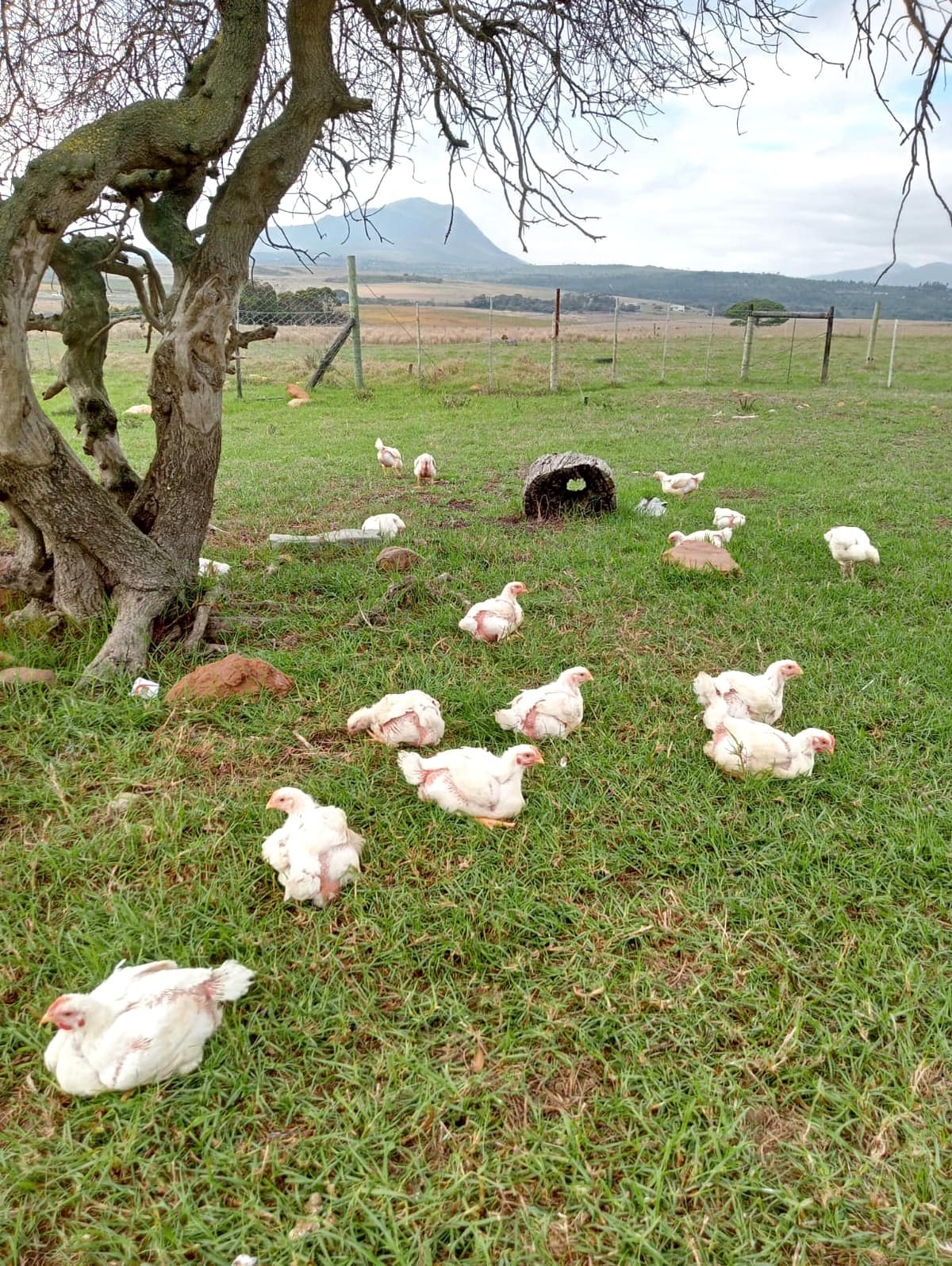
Our chickens are outside on grass. There are trees for shade and the Overberg hills behind them, and they move around during the day rather than standing in a shed. When a bird needs handling, it is handled by hand, calmly, because a worked-up bird is no good to anyone.
We are not going to write a page of welfare claims and comparisons with other farms. We keep birds in a way we are willing to describe, and we are willing to show you. If you are nearby, ask about seeing them.
What we will not do is use words we have not earned. We do not say "pasture-raised" or "beyond organic" or any of the other phrases that sound like standards but are not. The description we use is the one we can stand behind: free range, kept outside.
Eggs and whole chicken: what we sell and when
We sell eggs and whole birds. Not cuts, not fillets — whole chickens, because that is the honest way to sell a bird and because the frame makes stock for the soups we sell in the pantry.
Eggs are the more regular of the two. Hens lay to their own rhythm and to the light, so some weeks there are plenty and some weeks there is enough for the standing orders. We collect and send them out fresh rather than holding them.
Chickens are available when they are ready, which is not the same thing as every week. If you are planning a specific meal, ask first. We would rather tell you "not this week" than have you build a lunch around a bird that does not exist.
Sizes vary, because birds vary. Tell us what you are cooking and we will tell you what we have that suits it. A whole bird also asks something of the cook: a roast, then stock from the frame, then a soup or a sauce from the stock. Nothing is wasted, and the second and third meals are the reason a whole chicken is better value than it first appears.
What to ask any producer
These are fair questions, and any producer should be able to answer them without reaching for a brochure.
- Are the birds outside, and for how much of the day?
- What is the ground they are on — grass, dirt, concrete?
- How much space does each bird have?
- What are they fed?
- Are they certified by anyone, and by whom?
- What happens when they stop laying?
The last one matters and is rarely asked. A farm that keeps hens for eggs eventually has hens that no longer lay, and how those birds are handled is part of the system. We would rather you asked us than assumed.
Why we do not use the word "certified"
We are not certified organic and we are not certified free range. Both words describe method here, not a certificate, and pretending otherwise would be the one thing that undoes everything else we say.
Certification is a formal process with inspections, paperwork and cost. It is worthwhile for farms that pursue it, and it gives buyers a shortcut they can trust. It is simply not a claim we hold, so we do not make it.
What we can offer instead is directness. You can message us and ask how the birds are kept. You can come and look. The relationship is short enough that there is nowhere to hide, which is its own kind of assurance.
Where to buy ours
Eggs and whole chickens go out with the weekly orders, and to restaurants and health shops in Hermanus, Onrus, Fisherhaven and Caledon. Availability moves, so the reliable way to buy is to ask what we have.
Read more about free-range eggs and chicken, or if you cook for a living, supply for your kitchen explains how a standing order works. If you want the wider picture of how we farm, our story starts with the soil.