What "in season" actually means here
In season means the plant is growing in the conditions it likes, at the time of year it likes them, and has not been pushed to be somewhere it is not. A tomato in February and a tomato in July are the same species and a completely different food.
The Overberg sits in the Western Cape's winter rainfall pattern. That shapes the whole year: the rain comes in the cool months, the ground holds moisture into spring, and the hot, dry weeks of summer ask different things of a grower. A bed that is perfect for lettuce in one month is a waste of water in another.
So seasonality here is not a marketing device. It is the practical answer to the question "what should we plant next", and it is the reason a farm box changes while a supermarket shelf does not.
The crops we build our year around
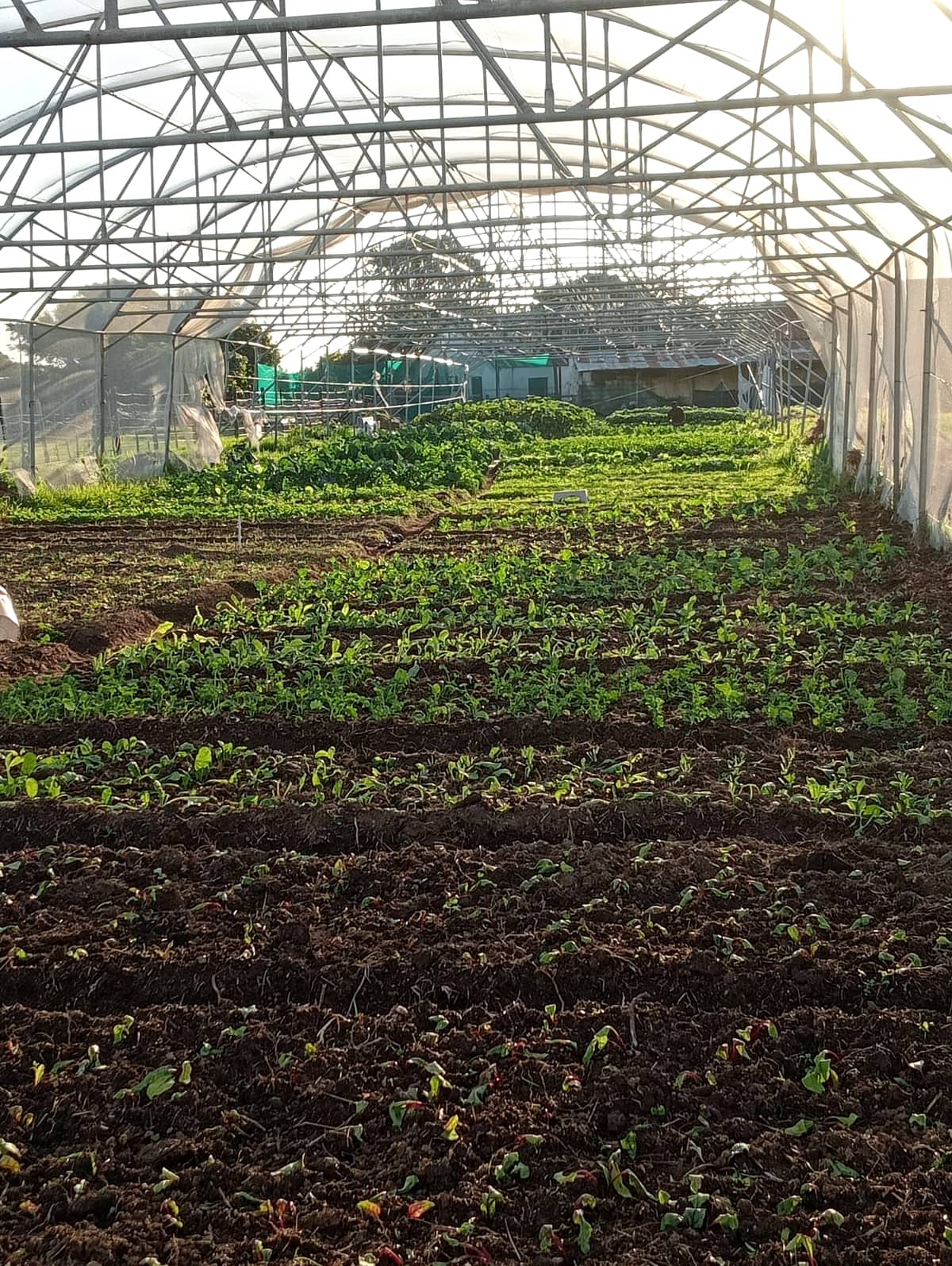
Six crops carry most of what we do: spinach, green beans, tomatoes, spring onion, lettuce and herbs. They are the ones customers ask for, the ones that work in this ground, and the ones we have learned to grow well.
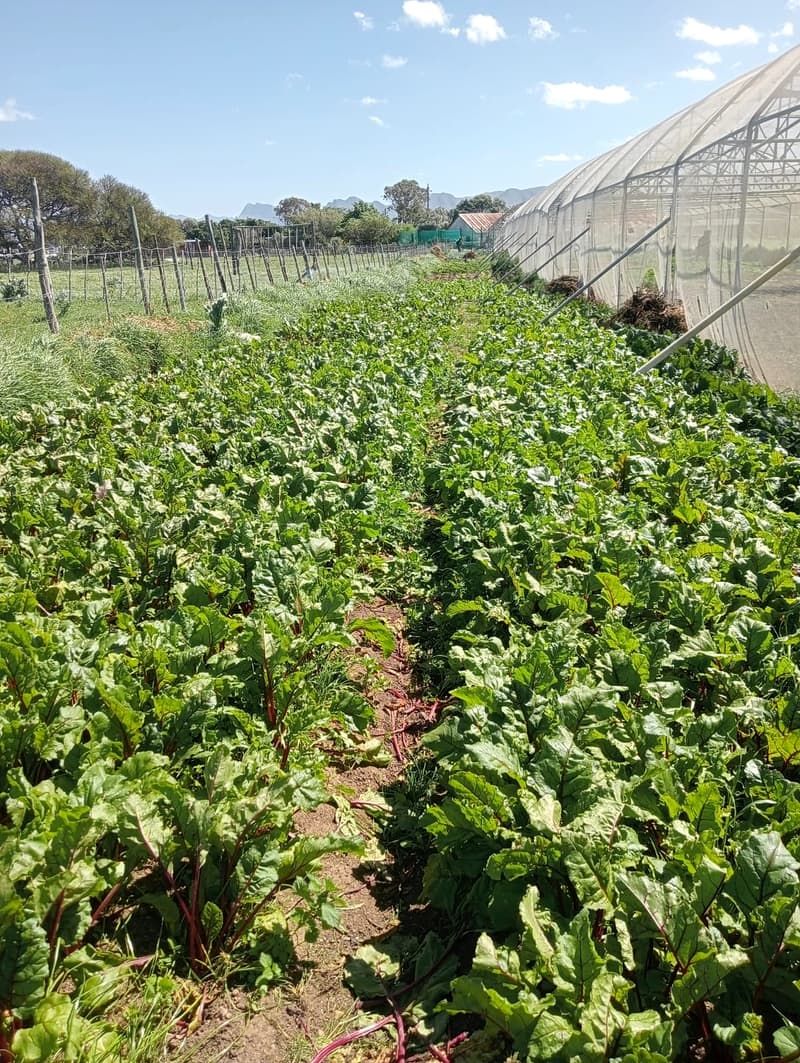
Around them sits everything else — chard, beetroot, patty pans, cucumber, carrots, leeks — the crops that fill out a box and make a week of cooking possible. Our own crates have carried all of them, some for a few weeks, some for most of a season.
The herbs deserve their own mention. Coriander and basil are the two that most often end up in a box or a jar, and both are quick: they come on fast and they finish fast. A herb bed is a good lesson in seasonality because you cannot pretend a herb is there when it is not.
How the weather changes what we pick
Two weeks can change everything. A hot spell brings tomatoes on and sends lettuce to seed in the same fortnight. A cold snap holds a crop back just as you had started to count on it. Wind does damage that takes a month to grow out of. Rain, when it comes at the wrong time, does more harm than drought.
This is the part of farming that no calendar captures. We plan in weeks rather than months, and we replan when the weather disagrees.
It also means the same crop tastes different at different points in its season. An early tomato is thinner and sharper than one from the middle of the flush. Late-season spinach is often better than the first cutting. Knowing that is half of cooking well.
Why supermarket shelves look different from a farm
A supermarket shelf is a supply chain, not a season. It is built so that the same item is available every week of the year, which means it is sourced from wherever in the world it is in season, stored, and moved. That is a genuine convenience and we are not going to pretend otherwise.
What it costs is the thing that makes produce interesting: variation. If a tomato is always the same, it is because it was chosen to be the same, and that usually means choosing a variety that travels rather than one that tastes of much.
A farm does the opposite. We grow what does well here, pick it when it is ready, and accept that the shelf will be emptier in some months than others. The compensation is that when something is on, it is really on.
How to cook with what is ready
The simplest approach is to start with the vegetable and work backwards, rather than starting with a recipe and shopping for it. A box of chard, a few spring onions and a bunch of herbs will suggest a meal faster than a cookbook will.
A few habits that help:
- Use the leaves. Beetroot leaves, carrot tops and chard stems are food. Wilt them, chop them, put them in a soup.
- Cook the soft things first. Lettuce and herbs do not wait. Roots will keep a week; a bunch of coriander will not.
- Let the vegetable be the dish. Good produce needs salt, heat and oil more than it needs a sauce.
- Make a pot when there is too much. A glut is what soup was invented for.
If you are unsure what to do with something in a box, ask. We cook with this stuff every week and we will tell you what we would do.
What to ask us this week
The only reliable guide to what is ready is a message sent this week. Ask us and we will tell you what is being cut, what is nearly ready, and what has finished. That is more accurate than any table, and it costs you one message.
Why there is no month-by-month table here
A season table is the most useful thing we could put on this page and the easiest thing to get wrong. A grid that says "tomatoes: December to March" would be wrong in a cold year, wrong on this farm in a wet one, and wrong for a neighbouring farm in the same month.
We could publish one and let it be approximately right. We would rather not. An approximate answer on a website becomes a promise in a customer's head, and we would spend the season explaining why the tomatoes are late.
So we do it the other way around. Ask what is ready, and you get the truth for this week rather than a guess for the year. Our seasonal veg packs are built from the same answer, and how the weekly pre-order works explains how to get one.
If you want the fuller picture of how the year moves, read what is in a weekly veg pack — it explains why the contents change and why that is the point rather than a flaw.